
 A while back we wrote a small article titled “You Can’t Be Average”; the article got a great deal of response, and one of the most asked questions was – OK, when talking about driving and Escaping The Kill Zone, (ETKZ) if not “Average” then “What is good”.
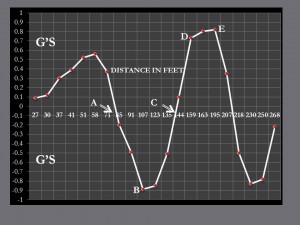
To answer the question we go to the data VDI collects to test their vehicles and produce the information that defines their test procedures and standards. The computer we use supplies data that charts – G’s vs. time – distance and steering wheel angle. The attached graph shows the G’s ,the amount of weight pushing on the vehicles center of gravity (CG), versus distance as Joe drives the VDI Suburban through a slalom course.
So to answer the question – what is the scientific definition of Escaping The Kill Zone or what is “good”. We get our answer by looking at the graph and examining the data.
From the graph we can see that at Point A there is very little weight being applied to the CG of the Suburban. At Point B on the Graph Joe is using a 100 % of the vehicle capability driving to the right. Now here is where the good driver part comes in. While driving from Point A to B Joe went from zero weight on the Suburban’s CG to using all the Suburban’s capability in 22 feet and .47 seconds.
Then driving from Point B to C he went from from 100% of the Suburban’s capability, back to Zero -in 41 feet and .8 Seconds.
Then while driving from Point C to D he went from zero weight on the vehicle to 100 % of the Suburban’s capability in the other direction and did that in 15 Feet and .33 seconds.
Driving from Point B to Point D Joe used 100% of the Suburban’s capability driving the Suburban to the right and then 100% of the Suburban’s capability driving to the left in 56 Feet in 1.13 seconds.

To define ETKZ and the difference between “Average” and “Good” – first consider the “Average “driver will use only 40% to 50% of the vehicles capability. So Joe drove the Suburban from zero weight pushing on the CG to using the maximum capability of the Suburban driving to the right and then back to zero and to the maximum capability to the left in 58 Feet and 1.6 Seconds. To be clear this is Joe driving – BUT – this is what all students must accomplish to meet the VDI standards.
The next discussion of “What Is Good” will be about the time Vs. G’s data. We will talk about the points on the Graph from D to E in the context of time. The D to E point on the graph is literally the killer. All VDI students have to experience the D to E phenomenon and be coached on how to recognize and control this vehicle characteristic.
Leave a Reply